The 1,183-Tonne Question: How Craft Chocolate Can Save the Cocoa Farmer
The people who grow the world’s finest cacao are disappearing. The craft chocolate industry may be their best hope—if it can survive long enough to help.
Somewhere in the Côte d’Ivoire — the country that produces nearly half the world’s cocoa — a farmer is making a decision. He’s 55 years old, which is roughly the average age of a cocoa farmer in West Africa. His life expectancy is about 62. He earns less than a dollar a day, well below the World Bank’s extreme poverty line. And today, he’s telling his daughter not to follow him into cocoa farming.
He’s not alone. Across the global cocoa belt, an entire generation of farmers is aging out of production, and the generation behind them is choosing to leave.
This is not an abstract crisis. It is the defining challenge of the chocolate industry, and it will determine whether the world’s supply of fine-flavor cacao survives the next two decades. It is also, perhaps surprisingly, a challenge that craft chocolate makers are uniquely positioned to address—if they have the right tools to sustain their own businesses first.
The Numbers Behind the Crisis
The 2025 Cocoa Barometer painted a stark picture: millions of smallholder farmers in West Africa remain trapped in poverty despite record-high global cocoa prices. The mechanisms that were supposed to help — forward-selling agreements, living income differentials, sustainability premiums — have largely failed to move the needle where it matters most: at the farm gate.
Consider the human development context. Côte d’Ivoire, which produces approximately 45% of the world’s cocoa, ranks 157th out of 193 countries on the UN Human Development Index, with a score of 0.582 — classified as “medium” human development. Nicaragua sits at 130th with a 0.695. Madagascar, one of my favorite origins, ranks 177th at 0.487. These are not countries on the margins of the cocoa economy. They are the cocoa economy. And their farmers are among the poorest agricultural workers on earth.
According to research from the World Economic Forum, up to 58% of cocoa farmers in Côte d’Ivoire and Ghana live below the World Bank’s extreme poverty line. Up to 90% do not earn what would be considered a living income. The average cocoa farmer in Ghana earns roughly 40% of what’s needed to cover a household’s basic needs.
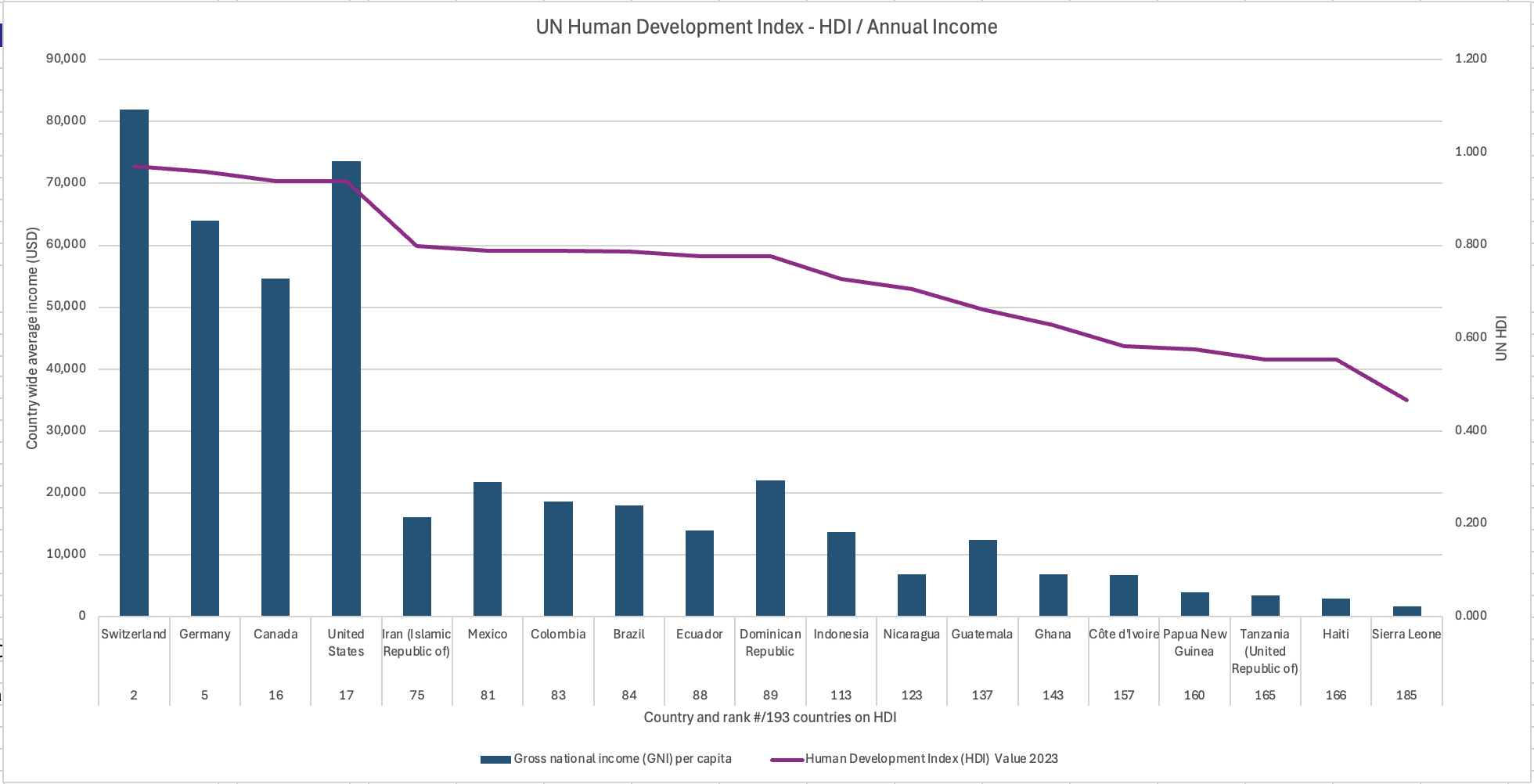
Select countries - HDI vs avg annual income (Source: UN Human Development Latest Publication, 2023)
Meanwhile, the workforce is aging. In Ghana, while over a third of the population is under 35, the average cocoa farmer is around 55. The younger generation isn’t rejecting farming because they’re lazy or disconnected—they’re making a rational economic choice. As one young Ghanaian woman put it in an Oxford University study: “Farming is tedious and difficult. There are no young people farming these days.”
Why Craft Chocolate Is Different
The commodity cocoa market doesn’t distinguish between a bulk Forastero bean destined for a mass-produced candy bar and a carefully fermented Criollo varietal with complex fruit and floral notes. Both enter the same system, get the same (or similar) farm-gate price, and end up as interchangeable inputs in a supply chain optimized for volume over value.
Craft chocolate makers operate outside that system. You often source directly from farms and cooperatives. You pay premiums — often two to five times the commodity price — for beans with specific flavor profiles, careful post-harvest processing, and traceable origins. Every bag of fine-flavor cacao you purchase is a bag pulled from the commodity cycle and redirected into a value chain that actually rewards the farmer for quality.
This is the mechanism by which craft manufacturing creates “fiscal oxygen” at the farm level. Higher prices for specialty beans give farmers a financial reason to invest in quality post-harvest practices, maintain heirloom varietals, and train the next generation. It’s a virtuous cycle — but only if the manufacturers buying those beans can stay in business themselves.
The 1,183-Tonne Opportunity
Here’s where the math gets interesting. There are now over 250 bean-to-bar chocolate makers in the United States alone, with additional operations across Canada and Mexico. It’s actually hard for me to count how many, I'm sure there’s more, but those are the numbers I'm confident in. If I project the growth of the North American craft sector and calculate the aggregate demand for specialty-grade cacao based on current production volumes and reasonable growth assumptions, the numbers point to approximately 1,183 additional tonnes of high-value bean purchases over a three-year horizon.
That’s 1,183 tonnes of cacao purchased at premium prices. Not commodity prices — premium prices that directly support farmer livelihoods, incentivize quality, and pull volume out of the race-to-the-bottom commodity market. For context, a single tonne of fine-flavor cacao purchased at specialty premiums can generate three to five times the farmer income of the same weight sold at commodity rates. That’s life changing for the farmer.
But that projection only holds if craft manufacturers can operate sustainably. And today, too many can’t — not because they lack skill or passion, but because they lack the operational infrastructure to run a tight business.
The Missing Link
A craft chocolate maker who doesn’t know their true cost-in-use for a bean lot is guessing at their margins. A maker who can’t generate a compliant nutrition panel without paying $1,000 to an outside lab is limiting their product line. A maker who can’t trace a quality issue back through their batch history is losing customers they could have kept and risking expensive FSMA compliance issues.
These aren’t failures of craft. They’re failures of tooling. And they’re the exact failures that cause promising small manufacturers to close their doors — taking their premium bean purchases, their farmer relationships, and their contribution to the specialty supply chain with them.
This is why Atlas exists. Not as a piece of software for software’s sake, but as the operational foundation that helps craft manufacturers survive and grow. Because every maker that becomes more profitable, more efficient, and more sustainable in their operations is a maker that continues buying premium beans from the farmers who need those purchases most.
It Starts at the Factory
Sustainability in chocolate doesn’t start with a label or a certification. It starts with a manufacturer who can afford to pay fair prices because they understand their own costs. It starts with a production operation that reduces waste because it can measure and track what’s actually happening in the process. It starts with a business that can grow its product line — and its demand for fine cacao — because the compliance, costing, and formulation work is handled by purpose-built tools instead of cobbled-together spreadsheets that are a nightmare to keep current.
The farmer in Côte d’Ivoire can’t fix the chocolate industry’s tooling problem. But the industry can fix it. And in doing so, it can build the economic bridge that makes specialty cacao farming not just viable, but attractive to the next generation.
1,183 tonnes. That’s the opportunity. That’s the question. And the answer starts with building businesses strong enough to follow through.